Schools
Arizona State University: Energy Justice Scholar Joins College Of Global Futures As Presidential Postdoctoral Fellow
Having the air conditioning running on a hot summer day can be a necessity to survive the heat. But keeping your home cool comes at a hi ...


Ashley Richards
2022-02-04
Find out what's happening in Scottsdalefor free with the latest updates from Patch.
Having the air conditioning running on a hot summer day can be a necessity to survive the heat. But keeping your home cool comes at a high cost.
For many, paying the energy bill can be a burden. People who have lower incomes and live in older, less energy-efficient homes often have the highest bills.
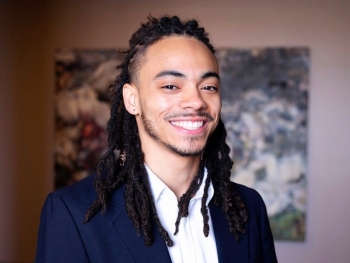
Dominic Bednar
Download Full Image
Find out what's happening in Scottsdalefor free with the latest updates from Patch.
For energy justice scholar Dominic Bednar, the problem of energy poverty is something he's working to solve. In fall 2021, he brought his work to Arizona State University's College of Global Futures as a Presidential Postdoctoral Fellow.
"Energy justice helps us understand how benefits and burdens are distributed across income and race," said Bednar, who joined the School for the Future of Innovation in Society and the School of Sustainability. "How do we move toward a just energy transition that centers equity and justice? Here in the U.S., we don't have any formal recognition that energy poverty is a distinct issue. Without first defining the problem, you can't effectively solve it. It also misguides how we measure the issue, and consequently misinforms how we evaluate deployed responses or solutions to the problem. We need to think deeply and critically about what energy poverty is and how it manifests in multiple different forms."
One of the principal areas Bednar is exploring is how residential energy efficiency can mitigate energy poverty, including home repairs that would save energy and lower energy bills. It's an interest that stems from his background in carpentry and engineering. After graduating with a bachelor's degree in civil engineering, Bednar narrowed his focus to sustainability and energy justice. While earning his PhD in environment and sustainability from the University of Michigan, he published a research paper on the challenges of energy justice and the effectiveness of federal energy assistance programs.
"Climates are different; governments are different, so not everyone is particularly on the same page," Bednar said. "I think there's a lot of confusion and misinformation that really stifles and stymies what our progress looks like. Another challenge is how we engage with people in a deeply authentic way that seeks to build long-term partnerships. What's the role of communities in this process of thinking about what our energy future looks like?"
Bednar is now preparing for his upcoming journey to Chile, where he will study energy poverty and efficiency as part of his Fulbright Scholar Award. His research will include the assessment of household energy needs and disparities using a community-based lens.
"I’m particularly interested in learning about Chileans' approaches to mitigating energy poverty institutionally and at the community level. Moreover, I’m excited to learn and watch how they develop a new constitution. I’m hoping to better understand and learn more about their energy needs and interests."
Bednar says the support he received in his first semester at the College of Global Futures has helped him pursue his research to find solutions to energy poverty.
"Everyone has the capacity to be disconnected from their energy, but what are the factors that make some people more vulnerable to energy poverty?" he said. "What makes some people more likely to fall behind on their utility bills or experience a utility shut-off? What ways can we move forward to anticipate those types of disconnections and move toward a future where energy is actually a human right for all?"
Americans are increasingly divided on everything from immigration to COVID-19 vaccines, from racial justice to foreign policy, and from voting laws to climate change. How can we engage civilly amid competing perspectives in politics and governance to rebuild the civic institutions that mediate our differences?
This question will guide an upcoming conference, themed "Renewing America’s Civic Compact," hosted by Arizona State University’s School of Civic and Economic Thought and Leadership on Feb. 25 and 26 at the Memorial Union on the Tempe campus.

Kmele Foster, co-founder and executive producer at Freethink.
The event will be held in person and streamed live by Arizona PBS on the school's YouTube channel. The school is accepting registrations here.
This year’s keynote speaker is Kmele Foster, Freethink co-founder and executive producer, who will discuss the limitations of modern social justice movements in the lecture “The World We Want to Live In: Racism, Race and the Dignity of our Individuality.”
“We look forward to discussing crucial challenges in the country during the conference,” said Paul Carrese, director of the school. “Our school is dedicated to promoting civil debates about pressing topics such as the current political polarization, which contributes to today’s civic crisis. By hosting forums for civil disagreement, we hope to help overcome this divide and to renew and enhance America’s capacity for self-governance.”
This divisiveness is also intellectual, and is experienced on college campuses across the country. Columnist, The Weekly Dish blogger and author Andrew Sullivan will join the discussion live via Zoom. He will speak on the impact of campus orthodoxy on American society, with an opportunity for an audience Q&A.
Conference attendees will also hear from some of the country’s top intellectuals and scholars, who are dedicated to reflecting upon America’s pressing social conflicts and the importance of civic education to finding a path on which Americans can move together to rebuild the public and private institutions to sustain civic, communal and professional lives.
“This year’s conference will offer an assessment of the challenges to American civic life and its institutions — including the university. We will also address how to rebuild the institutions and unity of our civil society," said Carol McNamara, associate director for public programs at the School of Civic and Economic Thought and Leadership.
The program is guided by Abraham Lincoln’s challenge in his first inaugural address on March 4, 1861: “We are not enemies, but friends. We must not be enemies. Though passion may have strained, it must not break our bonds of affection. The mystic chords of memory, stretching from every battle field, and patriot grave, to every living heart and hearth-stone, all over this broad land, will yet swell the chorus of the Union, when again touched, as surely they will be, by the better angels of our nature.”
The conference is part of the Civic Discourse Project, a series of lectures with some of the country’s most respected intellectuals and leaders. This year, Foster’s keynote address is also the culminating event of the three-part series “Can We Talk Honestly About Race?” The conference is co-sponsored by the School of Civic and Economic Thought and Leadership and ASU's Sandra Day O’Connor College of Law. It is supported by the Jack Miller Center, the Foundation Against Intolerance and Racism and the Scaife Foundation.
This press release was produced by Arizona State University. The views expressed here are the author’s own.
