Schools
Lake Denoon Students Hear Stories of the Holocaust
Survivors give their testimony so others will share the story, and hate will never be repeated.


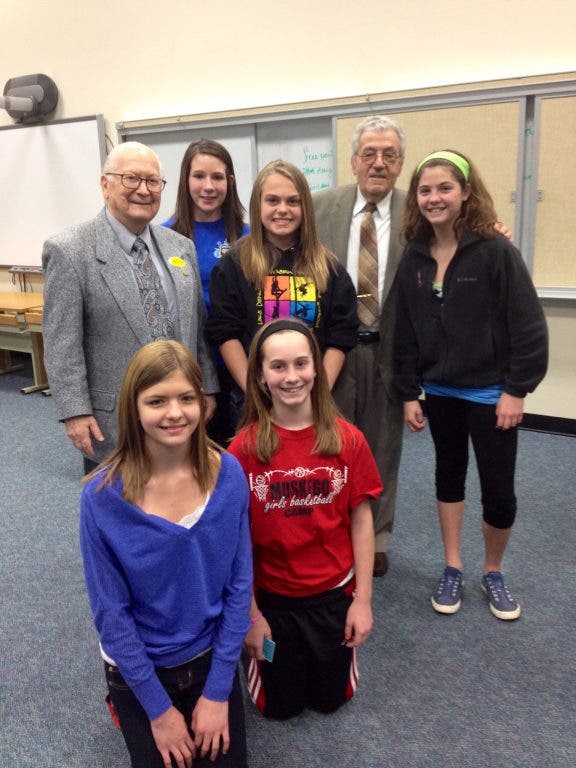
It gives you pause to think people these days can't stand each other for expressing political opinions, when two men who survived the Holocaust didn't give forgiveness a second thought.
Albert 'Al' Beder and friend Howard Melton were forced from their homes in Lithuania in 1941 as the German army occupied Kaunas (then Kovno) on their way to conquer Russia. They lived in a ghetto with about 30,000 other Jews, a population ten times than the area was built to hold. In 1942, they would travel from the overcrowded ghetto to a concentration camp in Riga, Latvia, and eventually to the infamous camp in Poland called Dachau.
Their 'revenge' they said was seeing the fall of Hitler, and the rubble of German cities.
Find out what's happening in Muskegofor free with the latest updates from Patch.
"If I would have lived only ten seconds after Hitler was killed, I would have died happy," Melton said. He was only 10 years old when he was separated from his family. He would only see his father and younger sister survive the occupation of Lithuania. Of the 37,000 Jews that lived in Kaunas, which was considered a center of culture and learning for the Jewish people, only 3,000 would remain by the end of World War II.
However, Melton and his 'older brother' Beder (pronounced better) said they don't hate Germany or its people.
Find out what's happening in Muskegofor free with the latest updates from Patch.
"What for? There were good Germans who helped people, and some of the soldiers we knew, especially toward the end, were good to us. They kept saying, 'don't worry...this war is going to end soon,'" Melton said.
Michael Schulteis, who teaches history at Lake Denoon Middle School in Muskego, had connected with Melton and Beder through the Milwaukee Jewish Federation, and has had speakers come before, but said the sad reality is that from year to year a few have died.
Beder and Melton visited about 185 students, parents and grandparents who sat in rapt attention as the men told their story. The questions asked after the talk are to the point.
"One boy asked Al how much he weighed when he was liberated, and he was told that at the age of 15, he was only 55 pounds," Schulteis said.
"We were given soup that consisted of weeds and rotten potatoes," Beder recalled. "We also had bread that was often moldy, but when you are hungry, it tasted so good."
Although faced with unspeakable images of death (Melton recalls seeing a dead body move because it was so infested with lice) and cruelty, the horrors of their reality also have forged a bond between the two that has made them more family than friends.
The two men, three years apart in age, were together from the time they were forced into the ghetto at Kaunas through their liberation from Dachau in March of 1945. Melton said the site of sweetened condensed milk reminds him of the Red Cross.
"The Americans were good to us. They came to us, and fed us this sweet milk, and nothing had ever tasted so good," he said.
They were transported to a hospital in Munich, and as returning home was not much of an option - Melton said returning prisoners were killed by the Russians because they were seen as traitors - Beder came to Milwaukee in 1947, with Melton following in 1949.
The talk at Lake Denoon is one of dozens they have given over the years, but they said it wasn't always something people wanted to hear, and it at first was a painful experience to relive.
"My family didn't really know of my whole story until the early 1990s," Melton said. "When you talked to people, they didn't want to hear it. I began to tell a woman I met in New York when I first came over about my experience, but she just said, 'oh we had it hard here too...there were times when we couldn't get bananas during the war.'"
Each man also took part in serving during the Korean War; Beder was drafted into the Army in 1950, and Melton chose to enlist in the Air Force around the same time.
Beder joined Melton in speaking before groups, and "at first it was hard, the experience was so painful, but it is so important to tell people, so they never forget," he said.
Beder is now retired from his own HVAC business, but Melton still takes part in his business, which includes a salvage yard and auto parts business in Miwaukee. They said they have enjoyed a beautiful life in America: each married and had children, grandchildren and great grandchildren. However, they feel people should constantly be aware of hatred.
Schulteis said kids have a greater awareness of their own feelings toward others after hearing the survivors speak. They see some of the same behavior in other places around the world, like Africa, where thousands of people die under cruel regimes. That, according to Melton and Beder, is the point.
"We come to speak for those who didn't make it back, or who can't speak now," Melton said. "There's a disease most people don't realize they have called hate that manifests itself in many ways."
"If I can change one person's mind or how they treat each other, I will be happy," he added.
Get more local news delivered straight to your inbox. Sign up for free Patch newsletters and alerts.
