Traffic & Transit
Aerial Gondola From Downtown Clearwater To Clearwater Beach Considered
A Tampa Bay Regional Area Transportation Authority survey asks residents their opinion about a 12-minute sky ride to reach the beach.


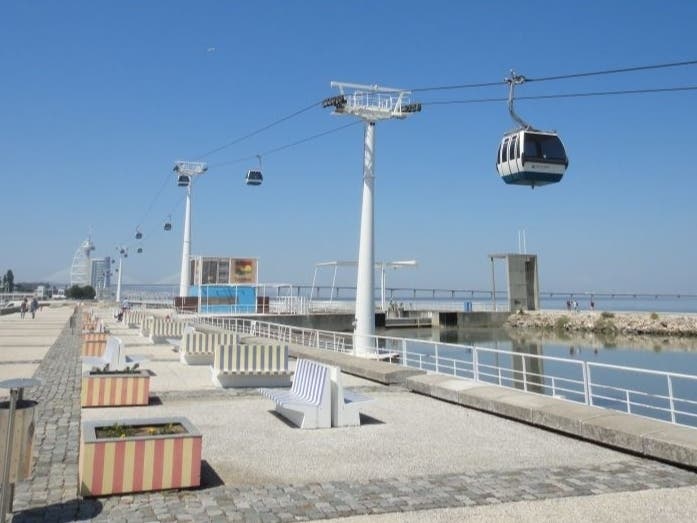
CLEARWATER, FL — What do Clearwater and other Tampa Bay residents think about building an aerial gondola most commonly used at entertainment parks and ski resorts to take people from downtown Clearwater to Clearwater Beach and back?
That's the question the Tampa Bay Area Regional Transit Authority is asking in a survey running throughout August as part of a two-year study to see if this emerging mass transit system is worth considering in Pinellas County.
TBARTA, the agency that coordinates road and mass transit improvements among the counties in Tampa Bay, has posted the anonymous survey on its website and Facebook page, asking residents in Clearwater and beyond to take a couple of minutes to answer 10 questions about using this mode of transportation that Tampa Bay residents normally associate with Busch Gardens and Disney World.
Find out what's happening in Clearwaterfor free with the latest updates from Patch.
While TBARTA emphasizes that there are currently no plans to construct an aerial gondola, or overhead cable car, in Clearwater, the authority is seeking feedback to help officials with any proposals that may come before them in the future.
The survey notes that the trip by gondola from downtown to the beach would take about 12 minutes one way, and asks if residents would be interested in using this mode of transportation to avoid the often-congested Clearwater Memorial Causeway bridge.
Find out what's happening in Clearwaterfor free with the latest updates from Patch.
In a related question, the anonymous survey asks if residents avoid going to the beach due to the congestion on the causeway.
TBARTA also wants to know if residents would only use the gondola for beach trips or would residents who work in Clearwater Beach use it to commute to their jobs.
Why Consider An Aerial Gondola?
This isn't the first time the idea has been floated in Clearwater.
During spring break, on holidays such as Memorial Day, Labor Day and the Fourth of July, and on weekends during peak tourist season, traffic from downtown Clearwater to Clearwater Beach on the Clearwater Memorial Causeway bridge can be backed up for more than two hours.
On the other hand, according to Google Trip Planner, on Friday the estimated 2.4-mile trip from the Pinellas County Parking Garage at 310 Court Street in downtown Clearwater to Clearwater Beach via the Clearwater Memorial Causeway was just six minutes, half the time of a trip by aerial gondola.
The six-lane byway bridge across the Intracoastal Waterway is the primary access to Clearwater Beach, which is part of a string of barrier islands running from Tierra Verde on the southern tip of Pinellas County to its northernmost city of Tarpon Springs.
Completed in September 2005, the Clearwater Memorial Causeway is a six-lane byway connecting downtown Clearwater to the beaches on the other side of Clearwater Harbor.
The elegantly curved bridge with its greenways and pedestrian walkways is a luxury compared to the access between downtown and the beaches only 20 years ago.
The original Memorial Causeway Bridge was a two-lane flat span drawbridge built in September 1920. It connected downtown Clearwater and Clearwater Beach for nearly 30-plus years until it was replaced with a more modern drawbridge in the 1950s.
As the area's population grew and boat traffic increased, a drawbridge that had to be raised and lowered numerous times throughout the day, halting traffic to accommodate sometimes a single sailboat, became impractical. So, in the mid-1990s, the Florida Department of Transportation and city of Clearwater began exploring ways to replace it with a fixed bridge.
By the time a final design was chosen in 1998 and construction began in 2001, the cost of the S-curve alignment bridge built and owned by the Florida Department of Transportation mushroomed from a total cost of $45 million to $69.3 million.
And constructing the 2,540-foot-long span over Clearwater Harbor proved a nightmare. Three times during a two-year period, a major span of the bridge — the 1,362-foot section rising 74 feet above the middle of Clearwater Harbor to give boats clearance — had to be torn down and rebuilt because the reinforced steel and concrete support columns couldn't support the roadway. Each time the span was completed, cracks appeared in the columns, forcing the state to demolish the span and start over.
As a result, the causeway opened a year behind schedule. Nevertheless, within a few years, it, too, proved inadequate during the peak tourism season.
Even more problematic, planners predicted that the causeway, which is the major hurricane evacuation route for Clearwater Beach residents, would become a parking lot with traffic at a standstill if a total evacuation of Clearwater Beach became necessary due to an approaching hurricane.
After several international companies specializing in constructing emerging technologies including aerial gondolas, air taxis and hyperloops approached state and local transportation planning agencies, TBARTA decided to take a closer look at the idea.
In July 2020, it hired SCJ Alliance, an independent cable car consultancy group, to do an Innovative Transit Technologies Feasibility Study as the first step toward evaluating the potential of these three new types of mass transit.
From that study came a recommendation to explore local interest in pursuing an aerial gondola project in Clearwater and St. Petersburg. TBARTA and Forward Pinellas (the land use and transportation planning agency for Pinellas County) met with leaders from Clearwater and St. Petersburg, both of which showed an interest in a study.
Now in its second year with a projected completion date this fall, the study is assessing potential corridors for both cities. When completed, transportation planners will recommend whether to continue considering one, both or neither corridor and whether a more detailed environmental assessment or design-build study is needed.
Among the questions to be answered when the study is completed are:
- What is the purpose or need of a gondola in each proposed corridor?
- What areas of each city should the gondola service?
- How much will it cost to build a gondola operation, and who will pay for it?
- Once the gondola is built, who should own and operate it?
- What will be local government’s financial obligation to the gondola service?
- What technically valid aerial gondola options exist to meet each city’s purposes and needs?
- Which of those valid options is preferred?
- What are the technical, economic, social, environmental and political ramifications of implementing the preferred alternative?
- Should the agency proceed with one, both or neither of the preferred alignments?
Is It Worth The Cost?
Although both Clearwater and St. Petersburg city leaders agreed to study the idea, both cities have doubts whether the cost would be worth the effort.
For Clearwater leaders, who are currently spending millions to revitalize downtown Clearwater to entice residents and tourists to eat, shop and enjoy entertainment in the downtown area, it's a major concern.
The city already offers alternative mass transit systems between the city and the beaches, including the Jolley Trolley, a private, nonprofit service that operates throughout Clearwater Beach and the downtown area. The trolley service also serves the towns of DunedIn, Tarpon Springs and Palm Harbor.
Additionally, the Clearwater Ferry operates on weekends, taking people from downtown Clearwater to the Clearwater Beach Marina and North Beach in about 15 minutes. Forward Pinellas is now looking into the possibility of expanding the ferry service to connect St. Petersburg to Clearwater and other towns along the 37 miles of barrier islands along the Pinellas County coast.
And, the Clearwater Memorial Causeway bridge isn't the only connection between the mainland and the beach cities. Vehicles can use the Treasure Island Causeway, the Pinellas Bayway, Pasadena Avenue South, 150th Avenue, North Park Boulevard, Ulmerton Road and West Bay Drive, among others.
However, aerial gondolas have successfully reduced traffic in congested metropolitan cities including Medellian and Cali, Colombia; La Paz, Bolivia; London; Hong Kong, Caracas, Venezuela; Ankara, Turkey; Singapore; Algeria; Novgorod, Russia; and Santorini, Greece.
According to recent articles in the Wall Street Journal and New York Times, aerial cable-propelled transit systems are being considered in a number of American cities including Brooklyn, Washington, D.C., Chicago, San Diego, Seattle, Cleveland, Cincinnati, Buffalo, Baton Rouge, Austin and Miami, as well as Tampa Bay.
SCJ Alliance
Get more local news delivered straight to your inbox. Sign up for free Patch newsletters and alerts.