Community Corner
Tiny Bobcat Kittens Left Abandoned, Homeless Due To Florida's Rapid Development
After being scooped up out of their den by a construction excavator, four tiny bobcat kittens are being rehabilitated by Big Cat Rescue.


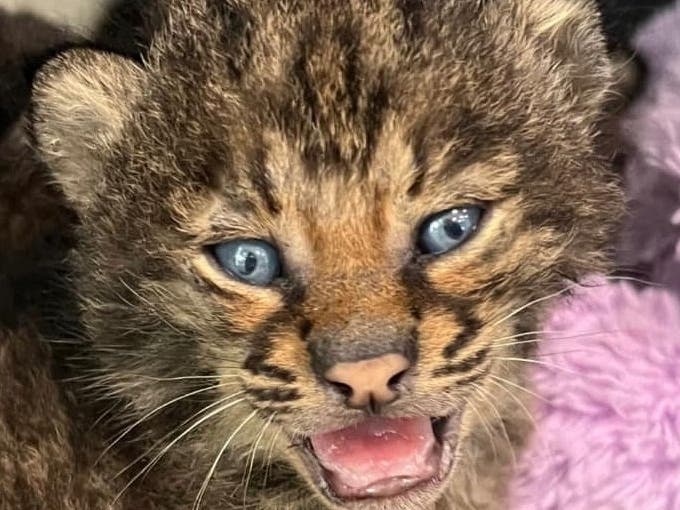

TAMPA, FL — Four tiny bobcats kittens have been rescued after being inadvertently scooped up by a construction excavator at a site under development in South Florida.
On Friday, Carole and Howard Baskin of Big Cat Rescue in West Hillsborough County received a call alerting them to the plight of the four kittens whose mother abandoned them after construction crews began clearing the property where she made her den and gave birth to the kittens.
"A large tract of land spanning thousands of acres was being cleared and, in doing so, an excavator disturbed the bobcat den," Baskin said. "After dumping a load, the machine operator noticed that there was something moving around in the rubble of vegetation."
Find out what's happening in Tampafor free with the latest updates from Patch.
Upon closer inspection, the excavator operator realized he'd accidentally scooped up three bobcat kittens, estimated to be about 2 weeks old, along with dirt and vegetation.
The construction crew searched through the rest of the debris and came up with a fourth kitten.
Find out what's happening in Tampafor free with the latest updates from Patch.
"Reuniting the mom with her kittens is always our first choice," Baskin said. "Unfortunately, because of the active land clearing, setting up a trap and hoping for the mom to return was not an option."
Big Cat Rescue, therefore, opted to rehabilitate the kittens.
Although the Baskins announced last month their plans to relocate the majority of the tigers, lions, leopards and cougars housed at their sanctuary to the spacious Turpentine Creek Wildlife Refuge in Eureka Springs, Arkansas, the nonprofit Big Cat Rescue is continuing its mission to advocate for, rescue, protect and rehabilitate big cats.
Right now, the tiny bobcat kittens— named Dutton, Loo, Kaye and Mare by the construction crew — hardly fit the image of big cats. But when full grown, the native Florida bobcats will weigh 15 to 30 pounds.
Dutton is the largest, weighing nearly twice as much as the runt of the litter, Kaye.
Kaye is very vocal and, being the runt of the litter, was the most excited to have access to all the food she could eat.
Mare's face is a lighter brown than her siblings, and some of her fur was scraped away.
"We were concerned it may be mange, but it has not progressed so may have just been an injury from being scooped with the excavator," Baskin said.
Loo is the quietest and arrived with a tiny cut on his nose from his close encounter with the construction equipment.
"Their mom had been taking very good care of the bunch, and they all seem quite healthy overall," Baskin said.
Related:
- 'Tiger King' Star To Close Tampa Big Cat Refuge To Focus On Wild Cats
- A Big Win For Big Cats; Tampa Animal Advocate Carole Baskin Celebrates
- Carole Baskin Tells Her Side Of Story In Discovery Channel Series
- Carole, Howard Baskin Tapped For TV Expose On Animal Exploitation
Big cat veterinarian Dr. Justin Boorstein gave the kittens full exams including blood tests for infectious diseases. They were also vaccinated, dewormed and treated for fleas.
Initially, the kittens are being bottle-fed, but will be weaned as soon as possible, so they don't become dependent on humans for food.
"The kittens will be raised together and released together once they are old enough to survive on their own, usually around 6 to 7 months old," said Baskin.
Their new home consists of 4,600 square feet of space in rehabilitation pens where they can roam, play and practice survival skills.
"They are raised with as little human contact as possible and given opportunities to learn to hunt," Baskin said. "They must prove they can hunt and survive before being released."
Florida's two native big cats, the bobcat and the Florida panther, are losing their habitat to development.
According to the Florida Fish and Wildlife Conservation Commission, Florida has the largest population of wildcats than any other state. There are about 300,000 bobcats living in Florida's swamps and forests.
However, their numbers are dwindling due to the development of their natural habitat.
They have no natural predators, so human beings pose the greatest threat to bobcats.
Bobcats are often struck by vehicles while crossing the roads that intersect their territories. Female bobcats have territories that cover around 6 square miles while males need about 30 square miles of territory to roam.
Bobcats are also vulnerable to hunters and poisoning from eating rats, squirrels and other rodents that have been dosed by rodenticides.
The nonprofit Big Cat Rescue is seeking donations to fund the care and rehabilitation of the bobcat kittens. Those interested in helping can donate here.
Dr. Justin Boorstein and Jamie Veronica Murdock, Carole Baskin's daughter, give the kittens a thorough exam.
Get more local news delivered straight to your inbox. Sign up for free Patch newsletters and alerts.