Community Corner
WATCH & LISTEN: Breaking Down Some Of The Data Leading Up To The 125th Boston Marathon
The 125th Boston Marathon is full of unique challenges for the 20,000 runners accepted to race on Monday.

October 8, 2021
With a new October race date, the largest pool of rejected qualifying runners in its history, a global pandemic and the next marathon only six months away, the 125th Boston Marathon is full of unique challenges for the 20,000 runners accepted to race on Monday.
Find out what's happening in Bostonfor free with the latest updates from Patch.
The Boston Athletic Association’s COVID-19 prevention measures drastically changed the conditions runners can expect to face during this year’s marathon.
The graphics below demonstrate how weather, field size and the virtual option have and will continue to affect race conditions leading up to Monday.
Find out what's happening in Bostonfor free with the latest updates from Patch.
Qualifying times by year
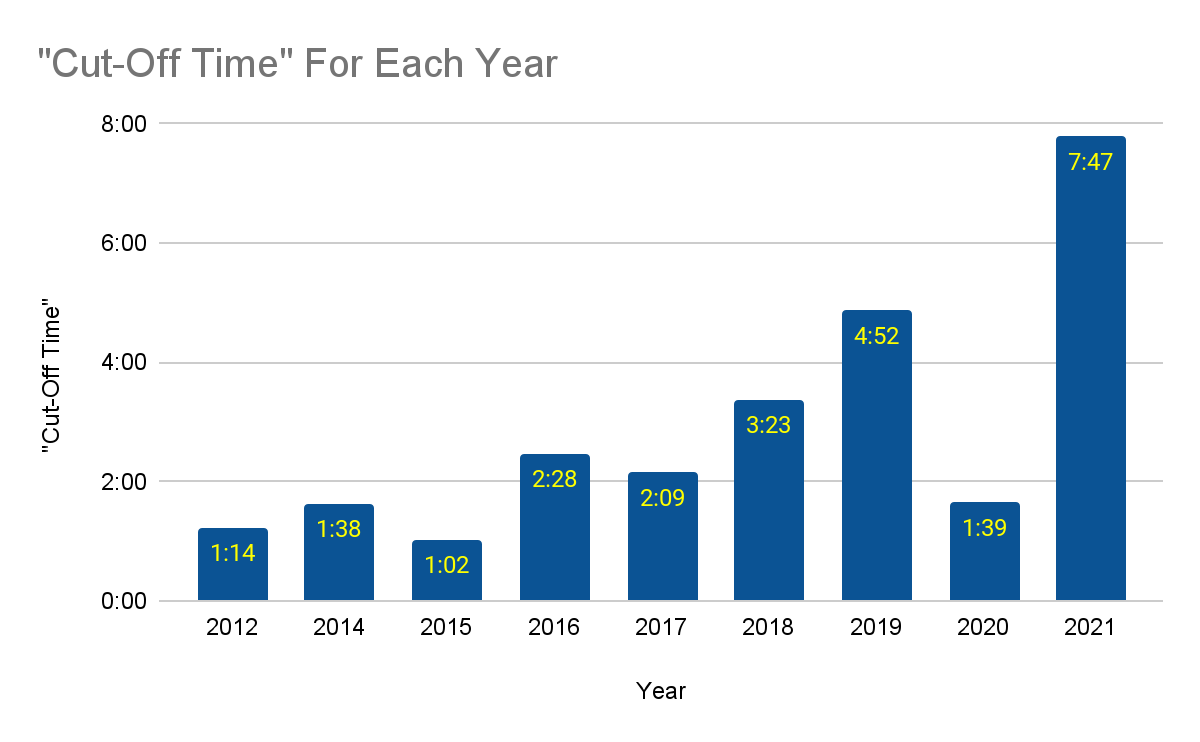
To qualify for the Boston Marathon, hopefuls must beat the maximum time designated for their age and gender. For example, men ages 18 to 34 must run a full marathon in three hours.
However, due to the Marathon’s growing popularity, the longest accepted time, also known as the “cut-off,” has consistently fallen under the three-hour mark since 2014.
The graphic below shows how much faster runners had to be than the qualifying time to participate in the Boston Marathon in this demographic.

Four runners racing in the marathon sat down to discuss the challenges they’re anticipating, how they’ve prepared, and what it feels like to run the Boston Marathon.
Gender breakdown by year
When women were first officially allowed to run the Boston Marathon in 1972, only eight women competed. Over time, female competitors became more common, leading to over 13,500 female entrants in 2019.
In-person entrants per year
The COVID-19 pandemic led the BAA to limit the participants to 20,00—a steep decline from 2019’s participant field and the Marathon’s all-time high of over 38,000.
Source: BAA.org
Makeup of field
While the marathon usually has a race field of 30,000, this year’s in-person field was cut down to 20,000, which includes the usual 2,400 charity runners.
Additionally, 27,707 runners will be competing virtually.
Source: BAA.org
Marathon Weather Effects
WetBulb Globe Temperature (WBGT) combines temperature, wind, humidity, and solar radiation to better reflect weather conditions, according to the National Weather Service.
According to a 2007 Medicine in Science and Sports Exercise study, when the WBGT increases by 9 degrees Fahrenheit, a marathon runner’s finish time will be slowed.
The study found that a first-place finisher was nearly 1% slower, while a 300th-place finisher was more than 3% slower.
BU News Service, an award-winning news site, is produced by Boston University journalism students. For more coverage of the Boston area visit bunewsservice.com