Politics & Government
Giant Kelp Reef Achieves Success
The 384-acre giant kelp reef built near San Clemente adds 35 tons of fish every year to the SoCal offshore environment




Wheeler North (1922-2002) was a marine biologist specializing in giant kelp ecology. He researched at the Scripps Institution of Oceanography and Caltech’s Keck Marine Science Laboratory in Corona Del Mar, and consulted for Southern California Edison (SCE) on the artificial reef project that would ultimately memorialize him.

Above: Dr. Wheeler J. North
On March 13, 2024, the California Coastal Commission (CCC) formally declared that the artificial reef bearing Dr. North’s name was a success.
Find out what's happening in San Clementefor free with the latest updates from Patch.
As partial mitigation for ocean impacts caused by the San Onofre Nuclear Generating Station (SONGS), the CCC ordered SCE to build an artificial kelp reef that would compensate for those impacts. A team of independent scientists determined that SONGS reduced the size and fish production of a nearby natural reef by 150 acres of kelp and 26 tons of fish, respectively. The Wheeler North Reef would be the cure for those impacts.

Above: Giant kelp plants rise to the surface from a few of the fifty-six 40m by 40m experimental reef modules built in 1999
Find out what's happening in San Clementefor free with the latest updates from Patch.
In 1999, after extensive siting studies, SCE built a test reef totaling 23 acres in 30-45 feet of water offshore from San Clemente State Beach. After 5 years, the test reef showed that many combinations of quarry rock or concrete rubble, placed on the sandy sea bottom, would naturally recruit giant kelp plants and that the resulting kelp forest would persist over time.

Above: Young giant kelp plants grow from concrete rubble, salvaged from the 1994 Northridge earthquake. Rubble comprised half of the 23-acre Phase I test reef.
Concrete rubble was tested because of its abundance at the Port of L.A. at the time - salvaged from freeways destroyed by the 1994 Northridge earthquake. Ultimately, SCE would add 359 acres of natural rock from a Catalina Island quarry in two phases to complete the reef. The estimated cost for the reef project is about $65 million, which adds about $0.0004 to the average monthly SCE electric customer bill over 30 years. Customers received the benefit of SONGS’ electricity generation over its 32 years of operation.
.JPG)
Above: A front loader pushes natural quarry rock from a construction barge onto precisely mapped areas of the sea bottom during Phase II construction of the Wheeler North Reef
Today, 25 years after its inception, the reef produces 35 tons of adult fish each year from the 359 acres of giant kelp habitat. This performance level exceeds the standards set by the CCC way back in 1996. Nothing worthwhile is instant.

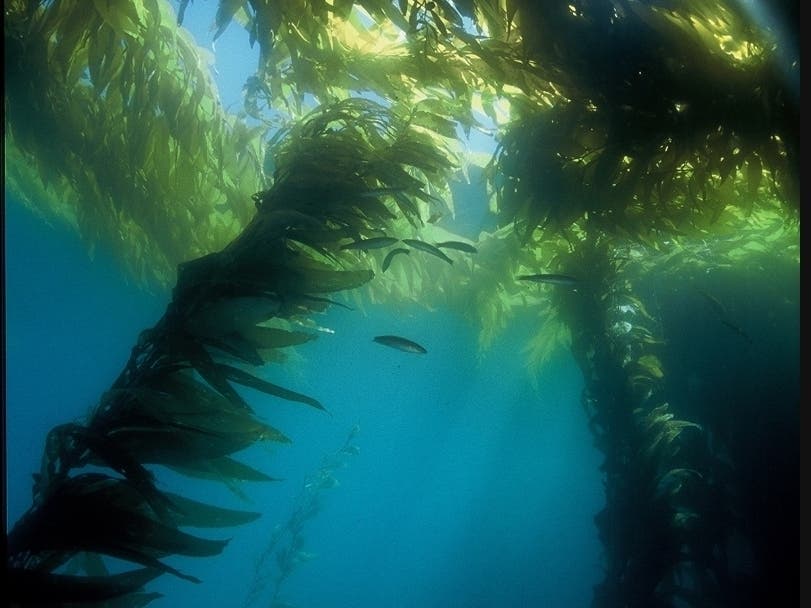
Above: Part of the Wheeler North Reef Giant kelp canopy. San Clemente Pier in the distance.
The scientific knowledge gained from the Wheeler North reef makes it possible for other similar reefs to be successfully constructed around the world. Low relief, small boulders and cobble, scattered at the proper depth provide the unstable foothold that giant kelp thrives on. The instability of rocks occasionally jostled and scoured by tides and currents prevents long-lived organisms, such as sea fans, from dominating the rock surfaces that giant kelp require.
Perhaps the next giant kelp reef will be built in Santa Monica Bay.

Above: Muricea, a long-lived invertebrate animal also known as a Sea Fan, competes with Giant kelp for space on reefs. Unstable reefs, such as the Wheeler North, prevent Muricea from gaining a foothold, to the benefit of Giant kelp.
References
California Coastal Commission staff report No. W6d-3-2024-report.pdf https://documents.coastal.ca.g...
Los Angeles Times. Man made rock reef is part of a welcome seaweed change. Tony Barboza. https://www.latimes.com/archiv...
Wheeler North Reef. SCE Community https://www.songscommunity.com...
Author’s disclosure of affiliations:
Dr. David W. Kay served on the Board of Directors of the non-profit Friends of Ballona Wetlands from 2007 until 2015, and served as Board President in 2012-13. He presently serves on the Board of Ballona Discovery Park in Playa Vista. Dr. Kay is a staunch advocate for the state of California's plans to restore the Ballona Wetlands Ecological Reserve.
From 1984 until 2022, Dr. Kay was employed by Southern California Edison Company, exclusively in the company's environmental services organizations. His many responsibilities included restoration of the 440-acre San Dieguito Wetlands near Del Mar and construction of the Wheeler North Giant kelp reef near San Clemente. He retired in 2022 as Senior Manager for Major Project Environmental Management at the company, after 38 years of service.
Dr. Kay earned bachelor and masters degrees in biology and a doctorate in environmental science.
See Dr. Kay’s Patch Community Contributor profile here.