Community Corner
Florida Southern College Home To World's Largest Collection Of Frank Lloyd Wright Designs
Famed 20th century architect Frank Lloyd Wright left his permanent stamp on Florida Southern College and the city of Lakeland.



LAKELAND, FL — Considered the most influential architect of the 20th century, Frank Lloyd Wright and the homes and buildings he designed in his pioneering Prairie School style of architecture are evident in a number of hotels, skyscrapers, churches, museums and homes throughout Chicago, where he opened his first architectural firm.
However, Wright didn't restrict himself to northern cities. Wright also left his mark in a big way on the city of Lakeland.
Florida Southern College at 111 Lake Hollingsworth Drive, Lakeland, is home to the world's largest collection of Frank Lloyd Wright buildings. Characterized by straight lines, rich oak molding, ceiling beams and wainscoting, abundant windows and the use of natural exterior building materials, the collection of buildings at the college have drawn architectural students and Wright fans from around the world to Florida Southern College.
Find out what's happening in Lakelandfor free with the latest updates from Patch.
Wright died in 1959 at age 91, leaving behind more than 1,000 buildings over his 70-year professional career. Twenty-eight of his projects have been designated National Historic Landmarks, including the campus of Florida Southern College, which encompasses 13 buildings constructed over 20 years.
Founded in 1852 as a Methodist seminary, Florida Southern is the oldest private college in the state. The school relocated several times during its early history before settling in Lakeland in 1921, purchasing a 67-acre former citrus grove to serve as its new campus.
Find out what's happening in Lakelandfor free with the latest updates from Patch.
After the college weathered the Great Depression, Dr. Ludd Spivey, the college's president since 1925, decided to find an architect who could transform the small, obscure college into the "campus of tomorrow."
Spivey aimed high, deciding to tap the greatest architect in America.
Wright was already famous for his Prairie School style of architecture and in great demand across the country.
To help fulfill all the requests for his services, as well as train a new generation of architects, Wright started the Taliesin Fellowship, a school for apprentices of architecture. Those architectural students helped him design three of his most famous buildings: the Johnson Wax Headquarters in Racine, Wisconsin; the Fallingwater home, which was built over a waterfall in Mill Run, Pennsylvania; and the Guggenheim Museum in New York.
Wright's popularity, however, didn't deter Spivey from attempting to enlist the architect's help.
Spivey sent a short, to-the-point telegram to Wright:
"Mr. Wright,
Desire a conference with you to discuss the construction of a great education temple in Florida. Please collect wire when and where I can see you.
Dr. Ludd Spivey, President, Florida Southern College"

To Spivey's surprise, Wright invited him to his Taliesin estate in Wisconsin to discuss the college president's proposal. According to Southern Florida historians, during that first meeting, Spivey promised Wright that, if he would design the buildings, Spivey would work tirelessly to raise the money to build them.
Wright believed in designing buildings that blended with the environment. So, before committing to Spivey, he insisted on surveying the natural landscape.
According to Frank Lloyd Wright expert, Aaron Betsky, the architect, who was nearing the end of his career at the time, was also intrigued with the idea of being able to design multiple buildings in a single location, something he'd never done.
Betsky recently lectured on Wright's affiliation with Southern Florida on the college's campus. A Yale University-trained architect, Betsky is the director of the School of Architecture + Design in the College of Architecture and Urban Studies at Virginia Tech and is the former president of the School of Architecture at Taliesin (formerly known as the Frank Lloyd Wright School of Architecture) in Scottsdale, Arizona. He is also the author of more than 20 books on architecture, including "Fifty Lessons from Frank Lloyd Wright" (2021).

Wright was 71 years old when he made his first visit to Lakeland on May 8, 1938.
Situated almost entirely on the slopes of a gently rolling 80-foot hill overlooking Lake Hollingsworth, the majority of the Florida Southern property was undeveloped and covered with citrus groves at that time.
Wright remarked that he could envision buildings on this landscape that would grow “out of the ground and into the light — a Child of the Sun.”
After spending a few days on campus and touring Central Florida, Wright returned to Taliesin to begin working on designs for the campus. He returned a few months later to present his master plan, together with his proposed design for the first building to be constructed, the Annie Pfeiffer Chapel.

Frank Lloyd Wright and his wife tour the college campus with Florida Southern President Ludd M. Spivey, right.

Wright returned a few months later to present his master plan, together with his proposed design for the first building to be constructed, the Annie Pfeiffer Chapel.
Over his 20-year commission with the university, Wright produced 18 building designs for Florida Southern, 13 of which were funded and built, one posthumously.
Today, the campus of Florida Southern College is among 28 Wright-designs projects that have been named National Historic Landmarks.
Frank Lloyd Wright Designs At Florida Southern
The Sharp Family Tourism and Education Center was opened on the university's campus as part of an effort to educate visitors about the Frank Lloyd Wright architecture at Florida Southern College.
Jack Coffey, manager of tours and educational programs at the Sharp Center, said it was a thrill to host the foremost expert of Wright architecture on the university's campus.
“Aaron Betsky has dedicated his life to learning, preserving and furthering the legacy of Wright's vision and architectural excellence," he said.
“You can’t be involved in American architecture and not be involved with Frank Lloyd Wright,” said Betsky.
He said Wright's philosophy on architecture, which Wright dubbed "organic architecture," changed the way the world looked at building design.
Unlike the fanciful, frivolous architecture of the Victorian and Art Deco eras in the 19th and early 20th centuries, Wright's designs were an extension of the Arts and Crafts Movement.
The Arts and Crafts Movement was a revolt against the mass manufactured items of the Industrial Age, said Betsky. The movement emphasized handmade furniture built by true craftsmen rather than factory-made pieces. Its architecture was characterized by simple floor plans and straight lines, locally sourced materials such as wood, stone, stucco and brick, exposed beams, rafters and earth tones.
These same features were the hallmark of Wright's designs.
What set Wright apart, however, was the care he took to incorporate his designs into the natural landscape. Wright believed that structures should be designed in harmony with the environment.
His first building at Southern Florida, the Annie Pfeiffer Chapel, was the nation's first college chapel with an architecturally modern design, according to Coffey. Construction began in 1938 and was completed in 1941. The result was a chapel with straight lines and angles, a 65-foot-tall bell tower and massive vaulted skylights that allowed the congregation to look up into the heavens as they worshiped.
Wright followed this first building with three identical seminar buildings built between 1940 and 1942, intended to satisfy the university's need for more classroom space, followed by the construction of the the E.T. Roux Library.
Due to labor shortages during World War II, the college used student labor comprised mostly of women to build the next five Wright-designed buildings.

Due to labor shortages during World War II, the college used student labor comprised mostly of women to build the next five Wright-designed buildings.
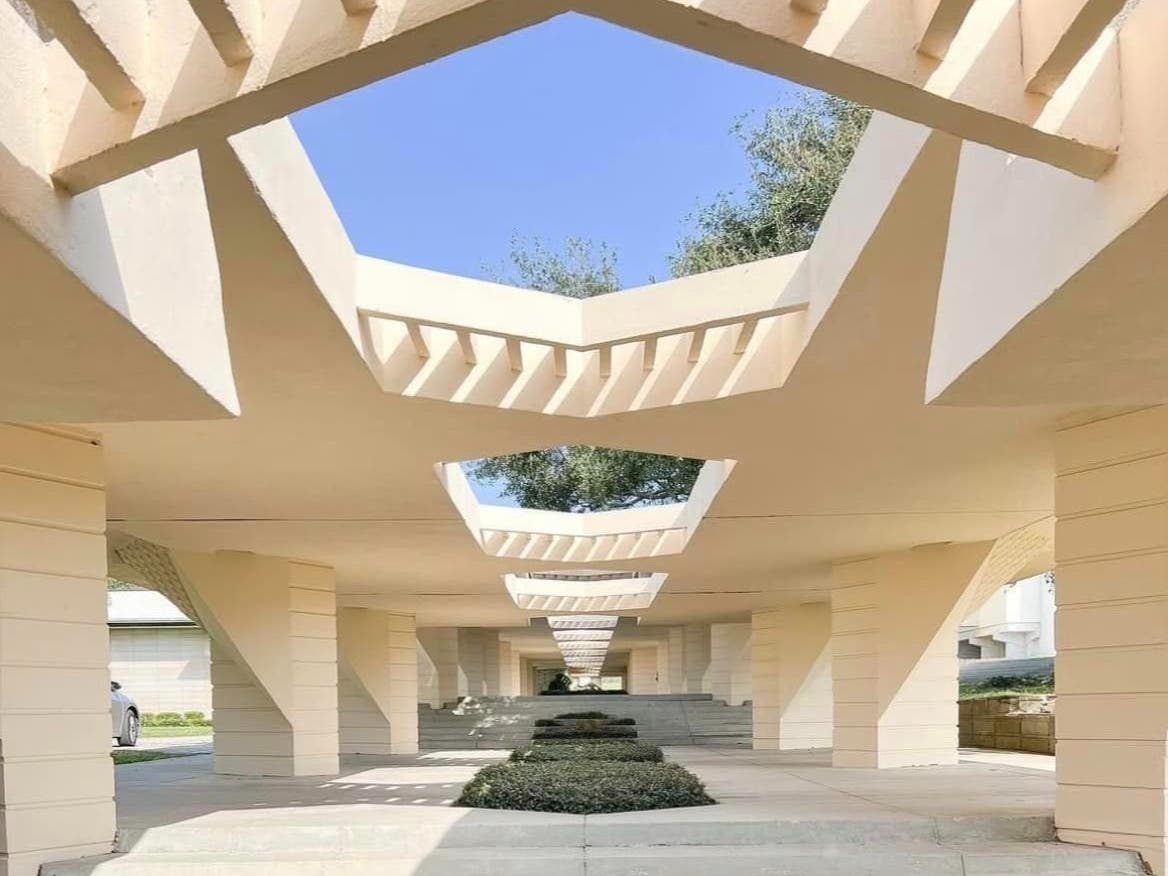
All the campus buildings designed by Wright were linked by the longest system of covered walkways in his career, known as the Esplanade. Stretching more than a mile, the Esplanade features uniformly designed columns, evoking the citrus trees that once filled the campus grounds.
In 1948, three more Wright-designed buildings emerged. The Emile E. Watson and Benjamin Fine Administration Buildings became the home of the school’s major offices, including the president’s office.
Completed nearly simultaneously, the Water Dome was the largest Wright-designed water feature in the world.
At that time, the Water Dome project was only partially built. The circular reflecting pool Wright envisioned couldn't be completed due to technical limitations at that time.

It wasn't until 2007, as part of the college’s ongoing efforts to restore and honor the architect’s original plans, that the fountain was completed to Wright's specifications, with a full dome of water reaching 45 feet into the air with the help of 75 water jets positioned around the perimeter of the large, circular pool.
Three more of Wright’s designs were constructed in the 1950s.
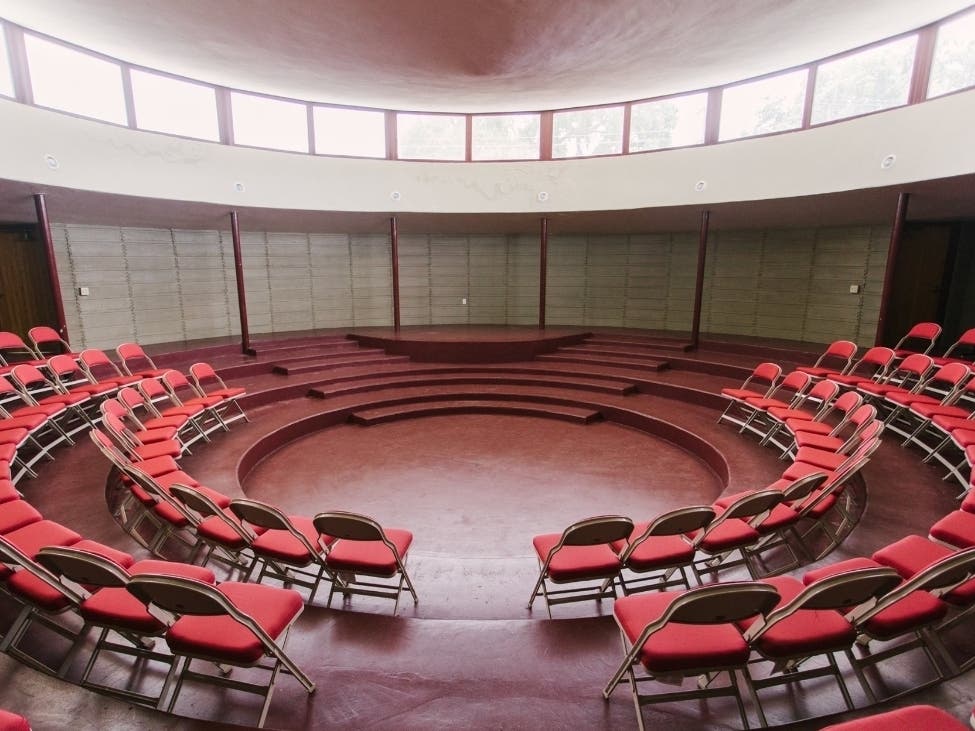
The Lucius Pond Ordway Industrial Arts Building completed in 1952 was built as a home for the college’s courses in carpentry, metalworking, automobile mechanics, cooking and home economics. The centerpiece of the building is the Fletcher Theatre, the only theater-in-the-round designed by Wright that was ever constructed. Today, the Ordway Building is the home of Florida Southern’s social sciences department.
The Polk County Science Building completed in 1958 is the largest of Wright’s campus buildings and the final building to be completed at Florida Southern during the architect’s lifetime. It contains the only planetarium that Wright designed and is one of a just a few buildings in his career to use aluminum aesthetic elements.
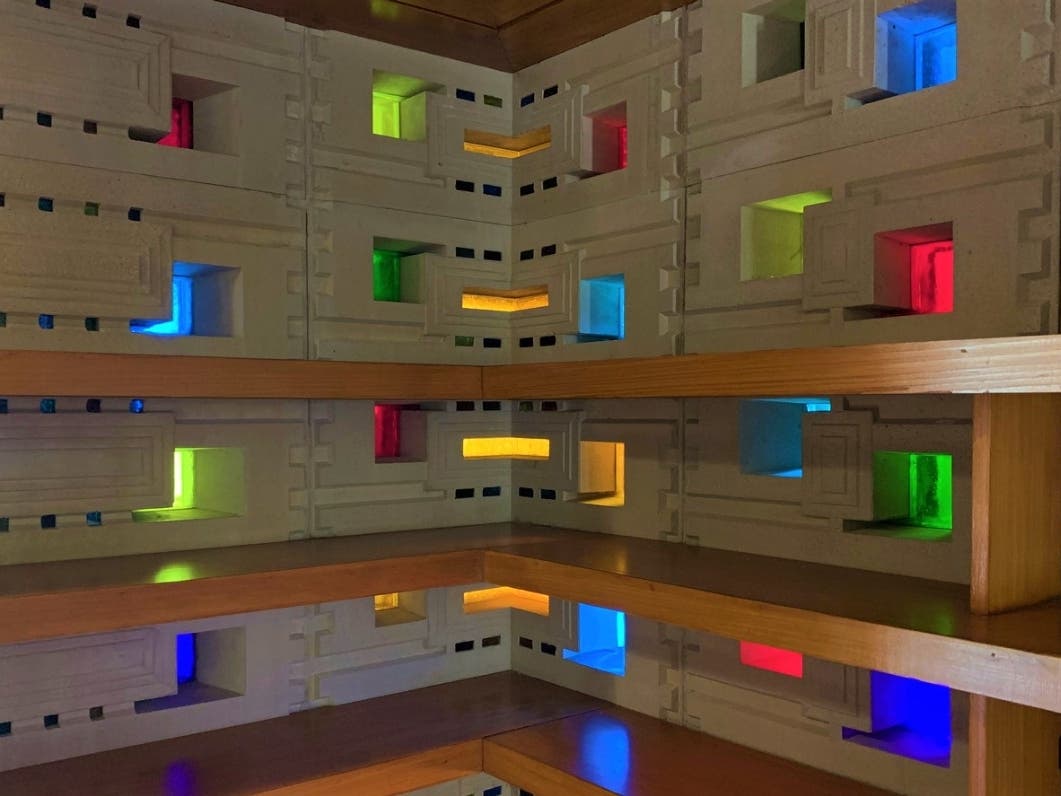
While the science building was being constructed, work was completed on the William H. Danforth Chapel in 1955, a smaller worship space for weddings and meditation. The Danforth Chapel is noteworthy for containing Wright’s last executed stained-glass window designs.
Spivey also had Wright design a single-family house, the first of what Spivey envisioned as faculty housing on the campus, a model for affordable housing for the typical American family.
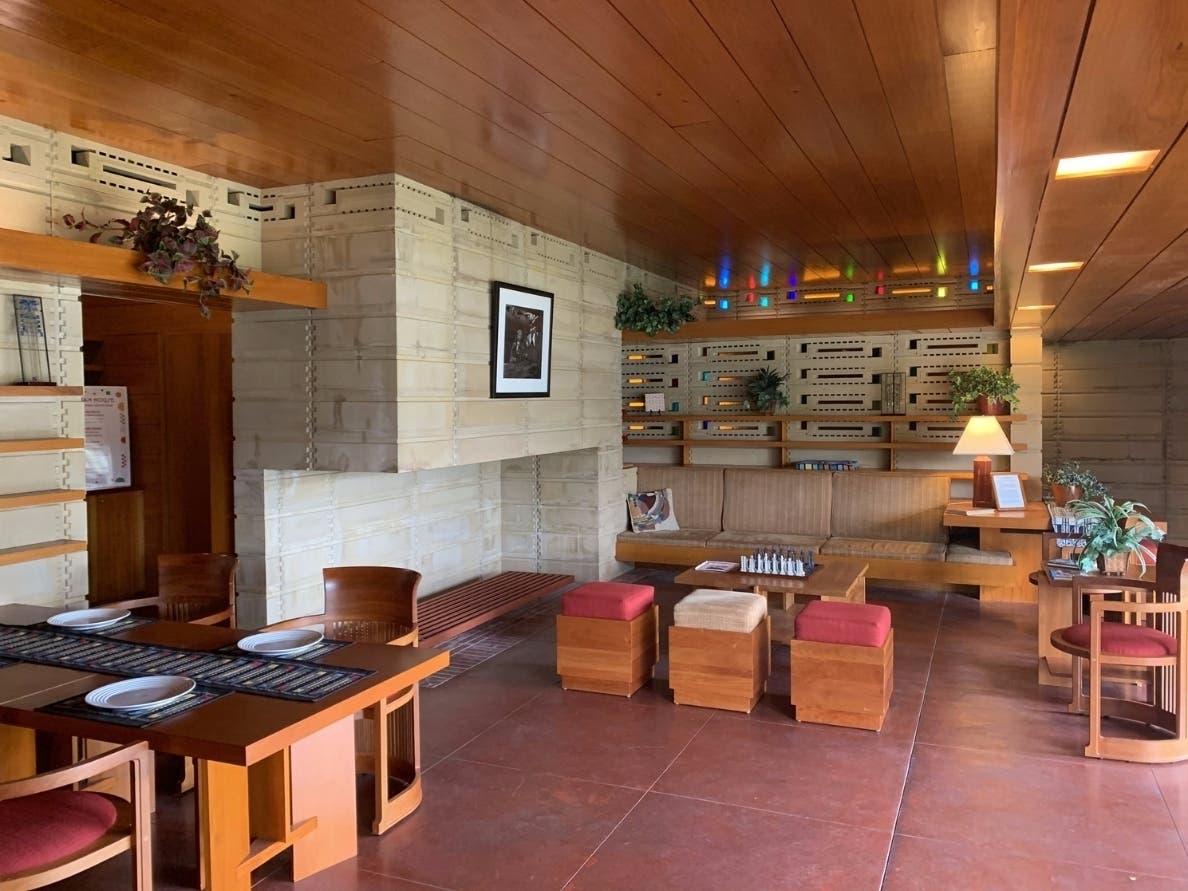
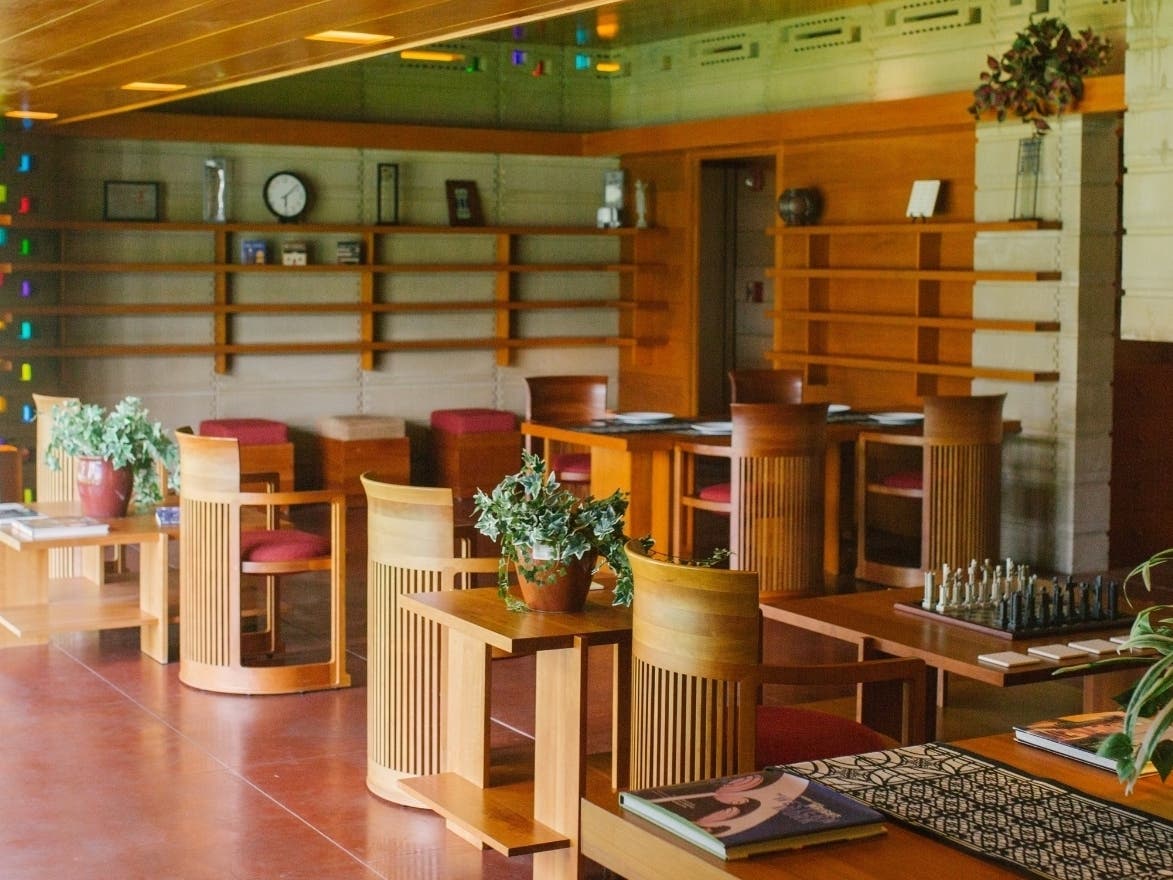
However, it wasn't constructed until seven decades later. Completed in 2013, the Usonian Faculty House became the 13th Wright-designed structure and now serves as home to the Sharp Family Tourism & Education Center.
Wright Architectural Tours
The Sharp Family Tourism and Education Center provides a home for the permanent display of photographs, furniture and drawings depicting Wright’s relationship with the college and also hosts visiting exhibits on loan from various other Wright sites.
The center invites the public to take self-guided tours walking tours. Self-guided tour maps marking Wright's 13 campus structures and information on the architecture can be purchased for $5 at the visitor's center from 9:30 a.m. to 4:30 p.m.
Guided tours of the Usonian Faculty House, furnished with period furniture, are $10 and include a showing of the film, “Frank Lloyd Wright’s Great American Campus.” Tours take place from 10 a.m. to 3 p.m. daily.
The Frank Lloyd Wright Basic Campus Tour is a 90-minute guided tour led by one of the visitor center's experienced docents. It features all 13 Wright-designed buildings as well as interior tours of the Annie Pfeiffer Chapel, the Danforth Chapel and the Usonian Faculty House. Tours are $30 and available daily from 10 a.m. to 2 p.m.
The Frank Lloyd Wright In-Depth Tour is a 2 1/2-hour-long tour that includes tours of the interiors of the E.T. Roux Library, Ordway Arts Building, Polk County Science Building, Annie Pfeiffer Chapel, Danforth Chapel and Usonian House. Tours are available daily from 10:30 a.m. to 1 p.m. and cost $45.
Visitors can also join one of the center's expert tour guides for a Behind-the-Scenes tour of Frank Lloyd Wright’s Child of the Sun campus. The 3 1/2-hour tour delves deep into the history and design of Wright’s structures on the Florida Southern campus. Included in the tour are all interior spaces offered in the tours above plus the interior of the only planetarium designed by Frank Lloyd Wright. The cost is $65 per person for these tours offered every Monday and Wednesday at 10 a.m.
The Wright After Dark Tour is a 90-minute journey across the grounds of Frank Lloyd Wright's only college campus after dark, providing a unique perspectives of thse structures. These tours include a look inside the Usonian Faculty House, the Annie Pfeiffer Chapel and the William H. Danforth Chapel at night. Reservations are required. The tours cost $25 and take place at 7 p.m. on the second Friday of the month from November through March.
Click here for tour reservations.
Get more local news delivered straight to your inbox. Sign up for free Patch newsletters and alerts.