Politics & Government
Malden Groups Call For Passage Of Chinese Ballot Transliteration Bill
Malden finalized a set of voter accessibility commitments last week. It now needs state approval for one remaining step.


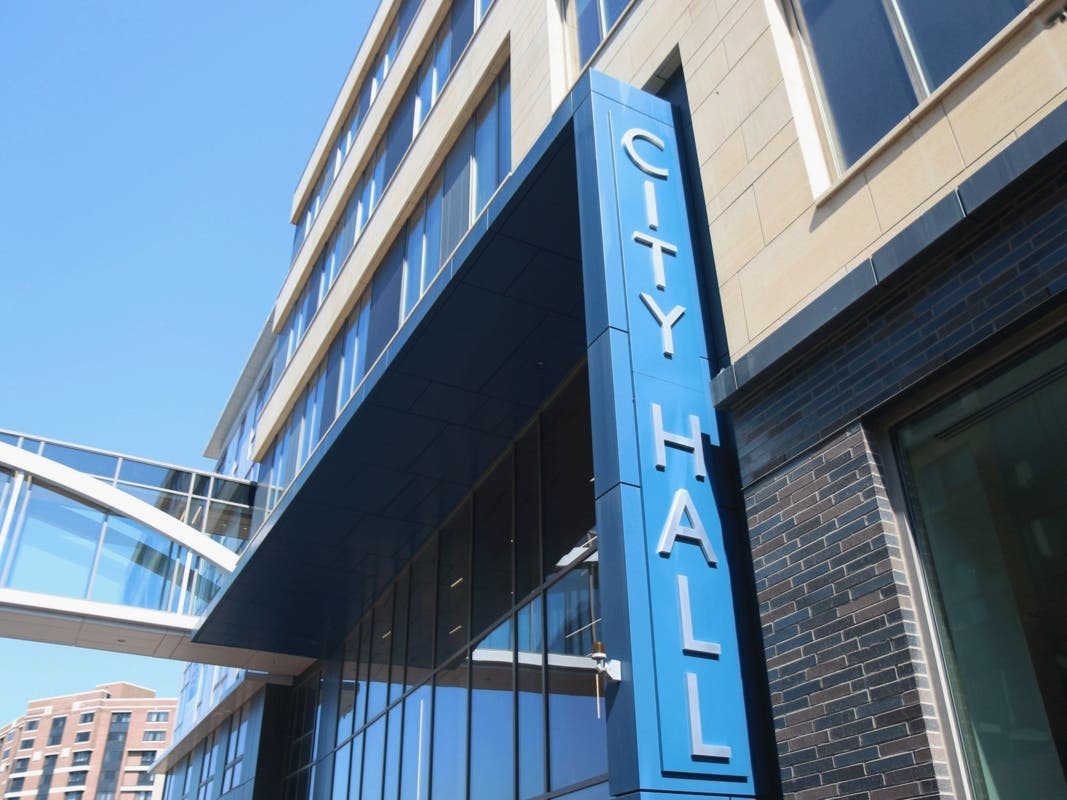
MALDEN, MA — Municipal and community leaders gathered at Malden City Hall on Wednesday to call for the passage of pending state legislation that would allow Malden to transliterate English candidate names into Chinese characters on future election ballots.
In the wake of a city agreement with various legal advocacy groups to add election accessibility measures for Chinese-speaking residents, ballot transliteration represents one final measure that is out of city hands at least for the time being, according to Malden Mayor Gary Christenson.
“We are committed,” Christenson said on Wednesday. “I know they are committed. There’s just one more piece and that’s having the state be committed by the passage of our home rule petition.”
Find out what's happening in Maldenfor free with the latest updates from Patch.
Voting accessibility has been a topic of debate and criticism in Malden for several years, with various poll watchers and groups alleging that the city violated the Voting Rights Act on multiple occasions as recently as last year.
The allegations hinged on Section 203 of the Voting Rights Act, which mandates certain multi-lingual election measures in communities where more than 5% of residents are classified as speakers of a particular language while having limited English proficiency, among other thing.
Find out what's happening in Maldenfor free with the latest updates from Patch.
In response to concerns, Malden inked its formal memorandum of understanding last week with the Asian American Legal Defense and Education Fund, Greater Boston Legal Services’ Asian Outreach Unit and the Greater Malden Asian American Community Coalition.
READ: Malden Commits To Chinese Language Election Accessibility Measures
The city made a series of promises in the document, including commitments to comprehensive translation of election outreach materials and better staffing of interpreters and bilingual poll workers at polling places.
The city also said it would work to provide transliteration of English candidate names on ballots.
Christenson said again on Wednesday that the city is on board with transliteration, which would involve phonetically translating candidate names into Chinese characters to appear alongside their English names on ballots.
The state House of Representatives has also backed the step, according to representatives Steve Ultrino and Paul Donato. That puts the legislation now in the hands of State Senate and Secretary of the Commonwealth William Galvin.
Galvin has publicly discussed concerns about previous transliteration efforts in Boston, which eventually took effect in 2014.
“Transliteration opens up a degree of uncertainty that’s not good to have in the ballot process,” he recently told the Boston Globe.
Galvin laid out a list of concerns back in 2007 as Boston debated transliteration at the time. As reported by the Globe, Galvin said that transliterations could create confusion or imbalance depending on how the process of selecting individual candidate name transliterations played out.
Boston’s transliteration debate continued for roughly six years before then Gov. Deval Patrick signed a permanent bilingual ballot bill into law in 2014. Boston was then a topic of discussion on Wednesday and a blueprint of sorts for recent efforts to bring ballot transliteration to Malden, according to speakers.

Karen Chen, the Executive Director of the Chinese Progressive Association explained that many of the 7.4% of Malden voters who are classified as limited English proficiency Chinese-speaking persons learn their preferred candidates' names based on Chinese-character transliterations, which are common in area Chinese-language media.
They then face confusion, Chen said, when they get to a polling place and see a ballot full of names written in the English alphabet.
“To some people, it may seem like it is a small issue,” Chen said. “But, actually, it’s very critical.”
“We know that this is important,” Chen continued. “We know that members of the community just want to vote.”
State Rep. Steven Ultrino called Malden’s transliteration bill a “no brainer” in comments on Wednesday.
“When you cannot read the ballot, we’ve denied you the right to vote and that is just un-American,” he said of the current situation.
State Rep. Paul Donato similarly voiced his support for the bill before State Sen. Jason Lewis took the microphone. Lewis, who also supports transliteration in Malden, discussed recent efforts by the state legislature to expand voting accessibility.
A “yes” to transliteration in Malden would be another step for that accessibility process, Lewis said.
“We are certainly committed,” he said. “I’m committed. My team is committed and I’m hopeful that with the continued support of the mayor and activists and voting rights advocates across Massachusetts, we can make the case that Malden should certainly follow the city of Boston (to transliterate its ballots).”

Regardless of comments this week, Malden is moving forward with early voting and election day voting this month in this year’s primary elections. These ballots don’t have the transliterations that advocates have called for.
The city has promised support for voters, however, circulating bilingual election materials in recent days and weeks while staffing up with personnel to help communicate with Chinese-speaking voters who do not speak English at the polls.
Early voting will wrap up on Thursday. Election Day is set for next Tuesday, Sept. 6.
Get more local news delivered straight to your inbox. Sign up for free Patch newsletters and alerts.