Politics & Government
American Views On Russia, Hacking Diverge Sharply On Party Lines
Republicans, in particular, began to feel much more favorably toward Russia quite recently.


New polling from NBC News and the Wall Street Journal found sharp differences along party lines in American views of Vladimir Putin and the Russian hacking related to the 2016 American presidential election.
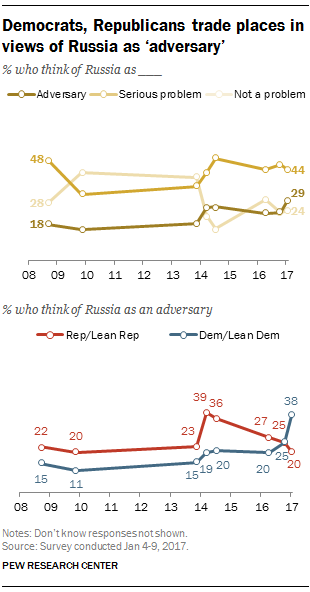
This data reflects previous trends showing Republicans with an increasingly favorable view of Russia and Democrats having an increasingly unfavorable view of the country's influence, despite the parties having relatively similar views on the topic in the not-so-distant past.
According to the new numbers, 63 percent of Democrats think Donald Trump's relationship with Putin is "too friendly." Only 7 percent of Republicans feel the same way; 44 percent say that the relationship is "not too friendly."
Find out what's happening in Across Americafor free with the latest updates from Patch.
Even starker divides emerge when you ask about the effects of Russian hacking efforts related to the election.
Seventy-eight percent of Democrats agree that Russia interfered in the election by hacking the Democratic National Committee — the position espoused by the American intelligence community — while 61 percent of Republicans disagree.
Find out what's happening in Across Americafor free with the latest updates from Patch.
Of those who agreed that Russia interfered, 84 percent of Democrats think the interference affected the outcome of the election, while 68 percent percent of Republicans do not think the hacks had an effect on the result.
(For what it's worth, election observers tend to think assessing the effects of hacking is very difficult.)
This polling reflects some pretty obvious partisan biases. It's not a surprise Democrats would be inclined to disfavor Trump's geopolitical views and to blame their candidate's loss on a foreign power. It's not a surprise that Republicans would be open to the president-elect's positions and skeptical of claims that his win might have come about via untoward means.
But the results are also in line with other longer-term trends showing a growing partisan split on American views of Russia. For example, from July 2014 to December 2016, Democrats' favorability of Putin dropped from -54 points to -62 points; in that same period, Republican's evaluation of the leader has drastically risen from -66 points to -10 points, as Will Jordan of YouGov pointed out:
Here is Republicans and Democrats on Vladimir Putin since July 2014. pic.twitter.com/s4I6FY5cbt
— Will Jordan (@williamjordann) December 14, 2016
Pew Research Center similarly found that the number of Democrats who see Russia as an "adversary" have risen sharply, while Republicans are less likely to describe the country in this way.
Not everyone falls easily into these partisan boxes, though. Sen. Marco Rubio, the Florida Republican, has repeatedly criticized Russia and Putin, despite Trump's reticence to do so.
“From his repression of the Russian people and the assassination of his critics, to his dangerous invasion of Ukraine and occupation of Crimea, to his threats against our NATO allies in Central and Eastern Europe, to the war crimes committed by Russian forces and their Syrian and Iranian allies in Aleppo, Putin’s Russia is a threat to global stability,” Rubio said in a statement before the end of the year.
Gen. James Mattis, Trump's pick for secretary of defense, took a much harsher stance toward Putin during his confirmation hearing than the president-elect has.
Glenn Greenwald, a notable Democratic Party critic who is usually seen as residing on the far left, has by contrast downplayed any threat posed by Russia.
Photo credit: Peter Souza
Get more local news delivered straight to your inbox. Sign up for free Patch newsletters and alerts.