Health & Fitness
Meningitis-Causing Parasites Detected In Giant African Snails In FL
About 3,000 of the giant snails, which have tested positive for rat lungworm, have now been found in a quarantine zone in New Port Richey.


NEW PORT RICHEY, FL — In the state's effort to wipe out the intrusive and potentially deadly giant African land snail, Florida Agriculture Commissioner Nikki Fried offered a good news-bad news scenario Tuesday.
The good news, she said, is the snails have been contained to the quarantine area in New Port Richey where they were first discovered in on June 21.
The bad news is the Florida Department of Agriculture and Consumer Services labs in Gainesville said some of the fist-sized snails have tested positive for rat lungworm, a parasite that can cause meningitis in people and animals.
Find out what's happening in New Port Richeyfor free with the latest updates from Patch.
In the past month, Fried said the department's division of plant industry has collected about 3,000 giant African land snails, or GALS for short, on 600 surveyed properties.
"Our division of plant industry has made great progress in the initial stages of eradication," Fried said. "One of the ways we gauge our progress is by observing the size of the quarantine and treatment area. If it remains the same, the population is isolated. And neither of these geographic areas has increased since the program started, and that is very good news."
Find out what's happening in New Port Richeyfor free with the latest updates from Patch.
However, she said the presence of the rat lungworm means the snails pose a health risk as well as being voracious eaters that can wipe out 500 varieties of plants, including entire fields of farm crops.
"With this detection, I want to remind consumers that these snails pose a serious threat to human and pet health. Do not touch or remove these snails," she said. "And, please, do not eat them."
She urged residents who find a snail to call the division of plant industry helpline at 1-888-397-1517.
Fried said there is no way to predict how long the eradication effort will take.
"We know from the past that eradication will take time," she said, adding, "Our partnership with the residents and local officials in Pasco County is and will continue to be integral to the success of this eradication effort."
See related stories:
- 1,000 Giant Snails Invade FL City, Dogs Used To Sniff Them Out
- Giant African Land Snail Invasion Causes FL Quarantine
- Due To Giant African Land Snail Sighting, No Compost Allowed Out Of Quarantined Area In Pasco County
The first time the giant African land snail was found in Florida was in 1969. It quickly multiplied in an area in south Florida, and it took the department of agriculture six years to wipe out 17,000 snails at a cost of $1 million.
The snails were found again in Miami-Dade County in 2011, and it took until 2021 to destroy more than 168,000 snails and millions of eggs at a cost of $23 million.
"They are one of the most damaging snails in the world," Fried said. "They can consume at least 500 different types of plants, making them a clear threat to our agricultural and natural areas. It is important to protect this vital industry from invasive pests like GALS that are recklessly brought into our state by illegal pet traders or other illegal means."
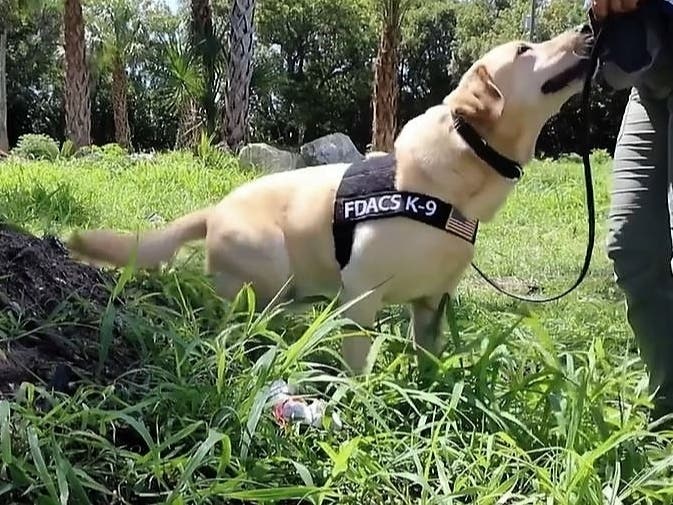
The department of plant industry has mobilized a veritable army of agriculture experts and specially trained snail-sniffing dogs to find and kills the snails using a metaldehyde-based molluscicide.
Approved by the Environmental Protection Agency for residential use, the snail bait in granules, sprays, dusts or bait pellets is applied to the ground where the snails are spotted.
Metaldehyde works by disrupting the mucus production ability of snails and slugs. This reduces their digestion and mobility and makes them susceptible to dehydration. Snails and slugs that have eaten metaldehyde often seek hiding places, become inactive and begin to die within days.
What makes eradication difficult is these snails can survive in a variety of environments, hiding in cool, damp spaces during the day and burying themselves in the soil and going dormant during unfavorable weather conditions.
The snails are also adept at traveling long distances by clinging to compost or yard waste that's trucked away, and they've been known to hitch rides on trucks carrying produce across the country.
For this reason, the department of agriculture has quarantined an area in New Port Richey starting at the northwest corner of U.S. 19 and Ridge Road, and proceeding east on Ridge Road, south on Little Road, west on Trouble Creek Road and then north on U.S. 19.
Additionally, the department has placed a ban on transporting compost outside the area under quarantine.
Believed to be originally from East Africa, the snail is now established on the Ivory Coast and Morocco, and throughout the Indo-Pacific Basin, including Guam and the Northern Mariana Islands, American Samoa and the Hawaiian Islands.
It is illegal to sell or possess them in the United States. Nevertheless, they are smuggled into the country as food, for pets or for religious ceremonies.
To date, the largest snail found in New Port Richey has been nearly 5 inches long, however, they can grow as long as 8 inches.
Get more local news delivered straight to your inbox. Sign up for free Patch newsletters and alerts.