Crime & Safety
Nashua Swears In New Assistant Fire Chief, William Atkinson
Atkinson has served the fire services since 1986 in Peterborough, Portsmouth, and Nashua since 1995. His wife, mother pinned his badge.


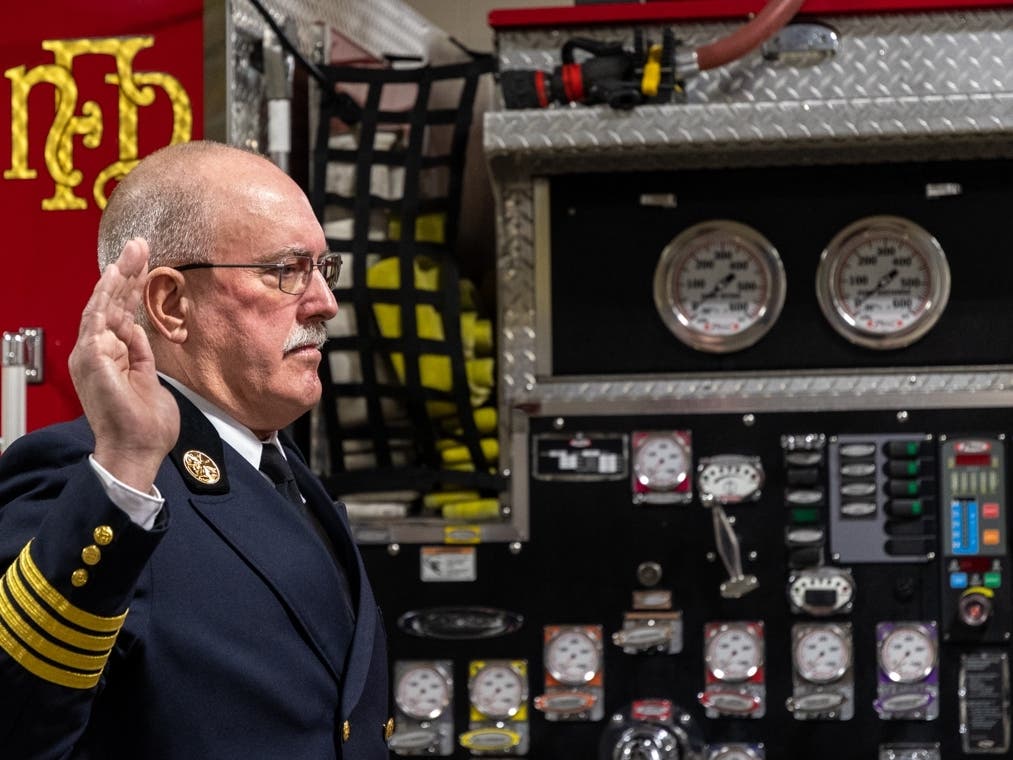

NASHUA, NH — Nashua Fire Rescue swore in its newly appointed assistant chief, William Atkinson, in a ceremony held on Sunday at Nashua Fire headquarters.
Atkinson is a native of Nashua. His love for the fire service started early. As a youth in Nashua, Atkinson would hear the horn from the central firehouse sound for a city box, he would then check the location on the city box sheet hanging in his family’s kitchen pantry, then hop on his bicycle to chase the apparatus to the scene of the incident. This was where his love for the fire service began.
Atkinson began his career in the fire service as a volunteer firefighter in Peterborough in 1986 while also working in Nashua at the family business, Bronze Craft. It was overwhelmingly clear early on that the fire service was his calling.
Find out what's happening in Nashuafor free with the latest updates from Patch.
Atkinson was hired as a career Firefighter/EMT in Portsmouth in 1993 and was appointed to Nashua Fire Rescue in 1995. He was promoted to lieutenant in 2004, captain in 2015, deputy chief in December 2020, and Sunday, to assistant chief.
Atkinson holds a Bachelor of Science degree in Public Service Management from Granite State College. He is also one of the original members of the SMART Hazardous Materials Response Team as a certified Hazardous Materials Technician and served as the hazmat team captain from 2015 to 2017. He has served as a member of the IAFF Local 789 finance board, and he holds numerous state and national certifications.
Find out what's happening in Nashuafor free with the latest updates from Patch.
Atkinson's wife, Gayle, and mother, Barbara, pinned on his badge after he was sworn in by Chief Steve Buxton.
At the ceremony, Atkinson asked to share the following story with you that he received from a friend of his who is a retired phycologist.
To summarize, the story tells of a woman named Pam who went for a mid-October day hike in the White Mountains. She was a well-prepared, experienced hiker heading out on the Jewell Trail toward the summit of Mount Washington. As she climbed, the weather, as is often the case in New England, began to change. Thick clouds dropped below the summit of Mount Washington; the temperature dropped to 24 degrees with wind-driven snow. As she hiked, she noticed some footprints in the snow and after a bit realized they had been made by a pair of sneakers.
The snow turned to sleet as she traversed the ridgeline; the visibility deteriorated to the point she was navigating from cairn to cairn. She noticed the tracks in the snow made a sudden left turn off the trail, she realized the person was obviously unprepared for the weather. She turned left and began calling out and blew her rescue whistle, then thought she heard someone reply. Wind gusts were now 50 mph. She slowly moved forward, where she found a man sitting motionless, cradled by a large boulder.
She began to talk to the man. He did not react. He was wearing tennis sneakers, shorts, a light jacket, and fingerless gloves. He looked soaked, his head was bare, and his day pack looked empty.
A switch flipped. Pam now stopped being a curious hiker and went into full rescue mode. As she asked questions he would not respond, his skin was pale and waxy and he had a glazed look on his face. He was hypothermic and in really big trouble.
She knew she didn’t have much time. She stripped him down placed adhesive toe warmers on his feet and dressed him in the spare clothing she carried. She checked for injuries and shared hot coca and chewable electrolyte cubes with him.
Still, he did not speak. Over an hour had gone by, he wasn’t working against her, but he was not helping either. She told him they needed to go now. At times he collapsed and she said “that’s not an option, we have to go.” After hours of emotional and physical toil, they arrived at the trailhead. Her climb to the spot where she located the man took 4 hours. Six hours had elapsed since then.
He just thanked her, got into his car, and drove off. She was stunned trying to figure out what just happened.
A week later the president of the Androscoggin Valley Search and Rescue group she belonged to received a letter in the mail. The enclosed letter went on to explain how on that Sunday in October the man went up to his favorite trail the Jewell Trail to end his life. The weather was to be bad, he thought no one else would be there; he dressed lightly to move fast.
The next thing he knew this woman named Pam was talking to him, changing his clothes, giving him food, making him warmer. Conditions were horrible and he told her to leave him, but she wouldn’t.
The entire time she treated him with care, compassion, authority, and the impression that he mattered. With all that was going wrong in his life, he didn’t matter to himself, but he did matter to Pam.
This story drives home that at some point in our lives, each of us has found ourselves walking with a sense of helplessness along a ridgeline and through a personal storm. Behavioral health is such a timely issue in emergency services.
This story rings true to Assistant Chief Atkinson's core value and he believes we all should always have a willing hand to help someone. You might be the only one that does.