Politics & Government
City Of Phoenix: Council Expands Code To Increase Pedestrian-Oriented Development Near Transit
The Phoenix City Council voted to expand the area of applicability for a current zoning code that encourages pedestrian-oriented develop ...


February 7, 2022 9:00 AM
The Phoenix City Council voted to expand the area of applicability for a current zoning code that encourages pedestrian-oriented development particularly around the use of high-capacity public transit. In 2015, the council adopted the Walkable Urban Code (WU Code), which provides a new option for development in proximity to light rail stations to encourage more people arriving by walking, biking, and using transit. It also encourages a stronger mix of land uses, supportive of small and large businesses, more housing options, more community amenities, and enhanced tree and shade standards all within walking distance to the light rail stations.
Find out what's happening in Phoenixfor free with the latest updates from Patch.
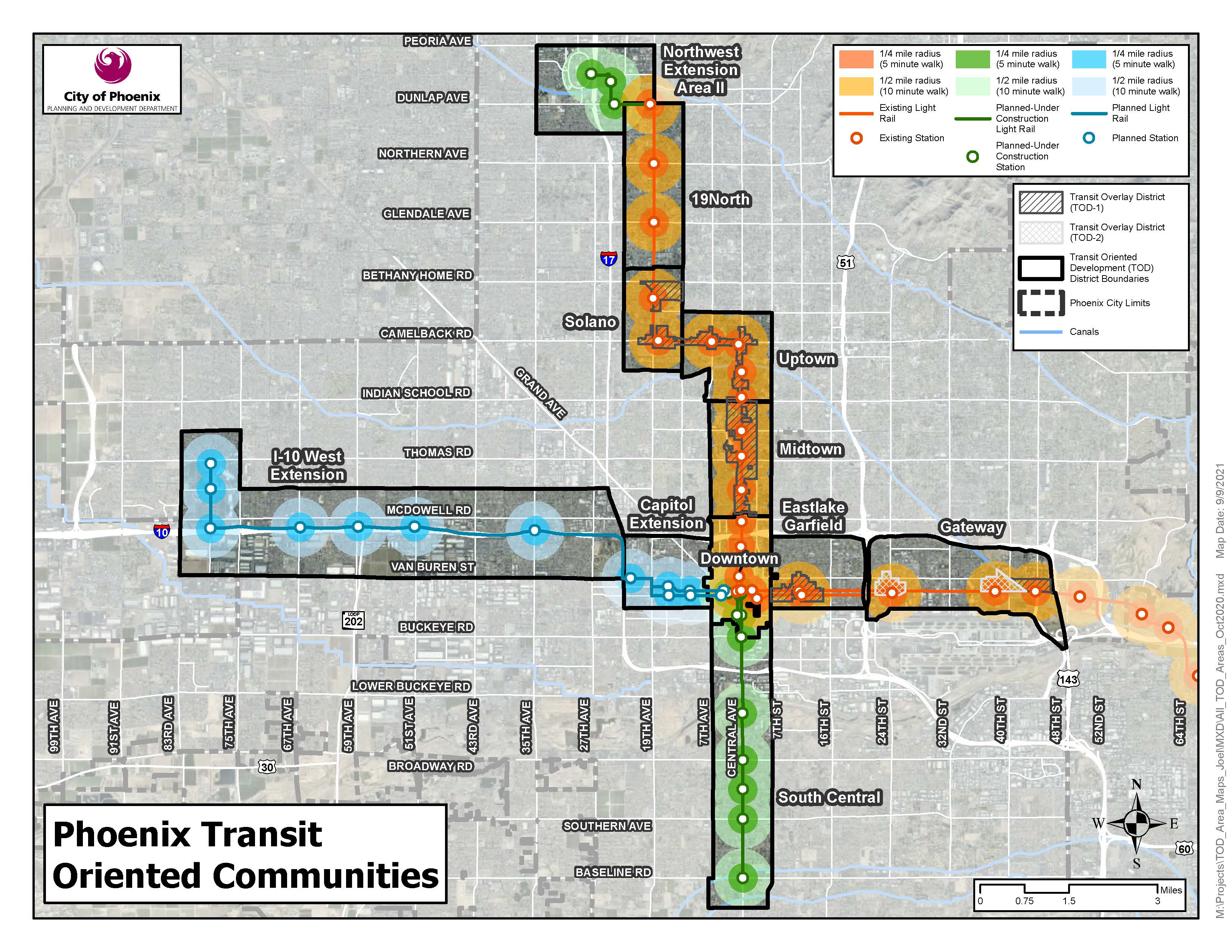
The WU Code originally applied to five Transit-Oriented Districts as shown in Map 1. This expansion adds six new planning areas defined geographically as transit-oriented communities in city adopted policy plans, the Federal Transit Administration's Transit Oriented Development (TOD) planning grant program or by their location in relation to light rail stations. These areas, represented in Map 2, are located on current and future transit corridors including 19North, South Central, Capitol and I-10 West Extensions, the area surrounding the 50th Street Station and the Northwest Extension Phase II areas.
The Walkable Urban Code is a form-based code that allows for increased flexibility for all development types. This will create a great opportunity for more flexible infill development and adaptive reuse. Expanding the Walkable Urban Code throughout the City of Phoenix will enhance development flexibility for all Phoenix businesses and property owners.
Find out what's happening in Phoenixfor free with the latest updates from Patch.
“This can be a great leap forward in terms of our planning policy as residents have asked the City to consider affordability, accessibility, and environmental healing and sustainability when it comes to new development," said Mayor Kate Gallego. “It allows us to really look at how streets work and use community-oriented tools to consider the character of a neighborhood."
A form-based code of this nature considers the character of the neighborhood by incorporating the visual and functional performance of the streetscape from a human scale, addressing how elements contribute to it and how they detract from it. This is different from the normal zoning code that primarily uses density when considering land use.
This is an ambitious rethinking of how the city builds residential housing and commercial businesses and has the potential to move us away from exclusionary practices to create sociable neighborhoods and provide diverse housing types.
A potential benefit is it could result in more "missing-middle housing," a range of house-scale buildings with multiple units—compatible in scale and form with detached single-family homes—located in walkable neighborhoods. These could be side-by-side duplexes, stacked fourplexes, courtyard apartment or condo buildings, townhouses and more.
The Walkable Urban Code provides a variety of options, known as “transects" to achieve more housing units in a walkable format consistent with community desires for growth and change. WU Code also provides additional incentives to locate more affordable housing options in these areas. Developers who opt into use of the WU Code are required to include pedestrian-friendly amenities in their design, such as enhanced building frontage treatments, increased trees and shade and contribute to a well-connected public-private open space network; all contributing to greater walkability. The WU Code is meant to encourage residents and visitors to walk, bike, and use public transit for their daily needs now and in the future.
Council voted 7 to 2 in favor of the expansion. Phoenix Planning and Development staff held over 42 meetings over the past few years inclusive of the city's 15 Village Planning Committees.
The Walkable Urban Code has been an important tool in facilitating the revitalization of several catalyst projects in the city's TOD areas, such as the redevelopment of Park Central Mall, redevelopment of Choice Neighborhoods Affordable Housing Project, and a contributing factor in a variety of infrastructure improvements such as the Grand Canal Canalscape Improvement projects.

This press release was produced by City of Phoenix. The views expressed here are the author’s own.
