Arts & Entertainment
Revealing Rothko!
A huge revelation is discovered by multidisciplinary artist / writer V. Borchert as she takes in the world of Rothko through his art at NGA.


"SILENCE is so accurate."
- Mark Rothko -
To understand Rothko's art, you have to look at his earlier work executed in the 1930's such as his works on paper in the watercolor medium depicting the world around him, his travels and his domestic life. Much like many of the greats, Rothko's first works were influenced by the French Impressionist painters. One can see the influence of Paul Cézanne in Rothko's green landscapes that present overlooks and forests. Enamored with Cézanne, Rothko follows in the French master's footsteps by having his wife, Edith Sachar, pose for him much like Cézanne did with his wife, Marie-Hortense Fiquet.
Find out what's happening in Washington DCfor free with the latest updates from Patch.
The National Gallery of Art does an excellent job in showcasing the evolution of Mark Rothko's work from his earlier more impressionistic figurative and landscape work to his later looser rectangular abstract shapes of color fields that he is so notably known for.
The exhibition gives one a thorough walk-thru the galleries presenting the growth and evolution of Rothko from his earlier impressionable work that relies on the artists he greatly admired such as Paul Cézanne, John Marin and later a strong influence from Joan Miró and ultimately coming to his own full circle or full rectangle in his case.
One can say that Rothko was almost escaping who he is as a painter and as a person by emulating the earlier masters that he so much admired. Eventually though with every work created slowly getting to know himself the person and ultimately almost giving up on making studies of these artists and allowing himself to fall into his own work which he seemed to be tip-toeing around all of this time. The avoidance in such becomes a tell-tale of the darkest secrets and the unspeakable emotions within him. To create his masterful deep fields of colors layered painterly on top of each other is to present layers of himself to the world. Avoidance of self-revealing had led him in a detour towards self-discovery and eventually succumbing to the person that he was. In such accepting his depression and falling into it and releasing it through his dark but so deep and provocative color fields. Just this act of expressing that I am done pretending, I am what I am and I embrace it in my work is a triumph by itself. Allowing oneself to completely expose through the arts is what Rothko did. The later signature rectangular paintings reveal the persona that Rothko was - Yes depressed, yes dark, but so much more.. an infinite of possibilities, a world of philosophy and a deep dive into the understanding of colors and shapes and their relationship of transcending us into a higher and spiritual realm. If we look at Rothko's progression, we do see his fascination with the deeply hurt, with the ones who were crucified, and put on the cross. He related to that experience, he related to the hurt. He took the pain within him and projected it into a beautiful transcendental modern tapestry of color blocks that float into an infinite space of monochrome which swallows us into its cosmic supernatural otherworldly existence. A Rothko painting can do that, and if you haven't achieved these sentiments and higher emotions that bring one inward, then you haven't absorbed the enormity of these works. It can be claimed that Rothko had unfortunately became immensely one with his work that he finally completely gave up and disappeared within them. His soul, though, is still very much alive in these brilliant color fields of works of art. This is why his work still resonates on such a deeply emotional level with the viewer. The work speaks to me like no other, I relate to its sorrow. It makes me feel like I am not alone in this melancholy and in this it rejoices one to feeling accepted and even embraced through its size and colors that bond it all together.
It seems to me that the best abstract artists are the ones who have started as figurative ones like Rothko, Diebenkorn and even Picasso. Those who hold a strong understanding of structure, anatomy and proportions tend to ease their way much more successfully into the world of abstraction which goes to tell especially budding artists who have never held a pencil to avoid shortcuts and take the steps needed to form a greater growth in their road towards abstraction. As an artist of many decades and also primarily a figuratively trained one, I fully relate to Rothko in his development that led to his remarkable later abstract works.
A revelation I have to reveal is that I discovered in this exhibition that Rothko's color-field work all stemmed from one singular figurative painting that is presented in this exhibition. The lady with the orange and black striped shirt is the origin and the root for all the striped abstractions seen later on in Rothko's career. It is as if, subconsciously rooted in the deepest folding of Rothko's brain, perhaps a deep love that kept him returning consecutively to creating those shirt stripes that become bigger and bolder with every abstract painting he unfolded later in his career. Look carefully and move that figurative painting into a vertical side and Eureka! just like that, you see it all in a shirt. The evolution of all his notable work of the 1950's and 60's all fall back to this figurative work done in 1933 "Untitled (Reclining Women on a Green Sofa)".
If you love Rothko, besides seeing this mesmerizing exhibition at NGA, do head to The Phillips Collection museum in Dupont Circle to see the "Rothko Room'' to view some of the best Rothko's I have ever seen.
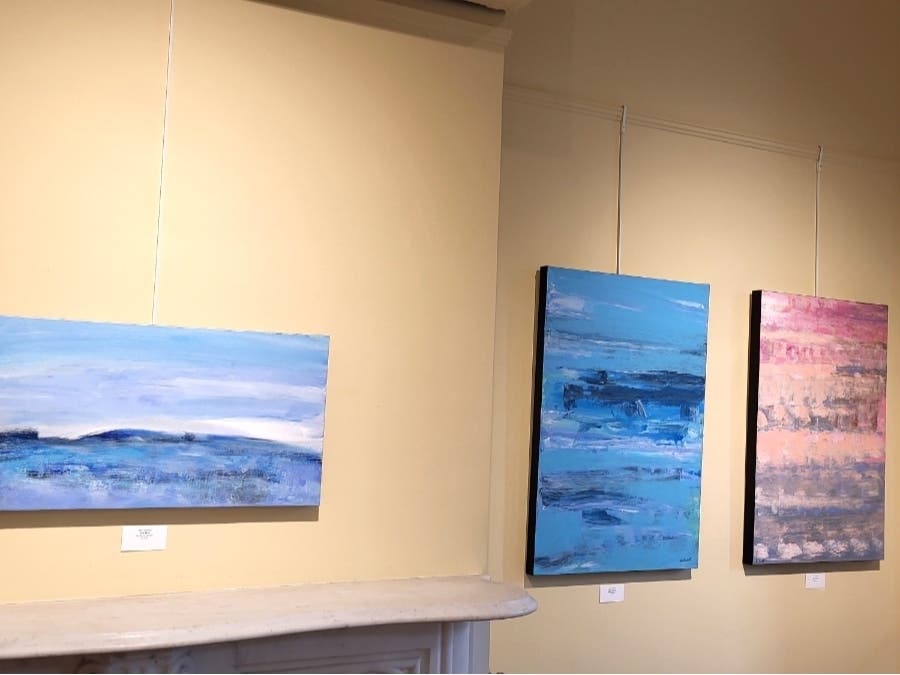
While you are doing art-sightseeing in DC, be sure to check out my exhibition of many of my signature abstract expressionist paintings currently on view for the month of February till Feb 24 at the historic and prestigious "Arts Club of Washington DC" where you'll be treated to my blue skyscapes and seascape abstractions that celebrate my love for nature and the environment. The paintings around 20 varying in size from medium to large present my meditative dive and the enchantment to my love of the Big Blue plays center stage in a number of these abstracted paintings that are an extension of who I am. A dreamer and one whose head is in the clouds, paintings of clouds playfully dancing within blue skies are translated in an abstract touch that aims to bring peace, harmony and rejuvenation to the soul. The exhibition is curated by art historian, Dr. Erich Keel of the Kreeger Museum in Washington DC. The paintings are on display in the "Monroe Gallery" within the Arts Club which was the residence of President James Monroe in the 1800's. Besides my paintings' exhibition, a photo collective showing is also on display for February within the Arts club's parlor. The "Arts Club of Washington DC" is located at: 2017 I St NW, Washington, DC 20006 - The Arts Club galleries are free and open to the public. Open Hours: Tuesday - Friday: 10AM-5PM, Saturday: 10AM-2PM.

